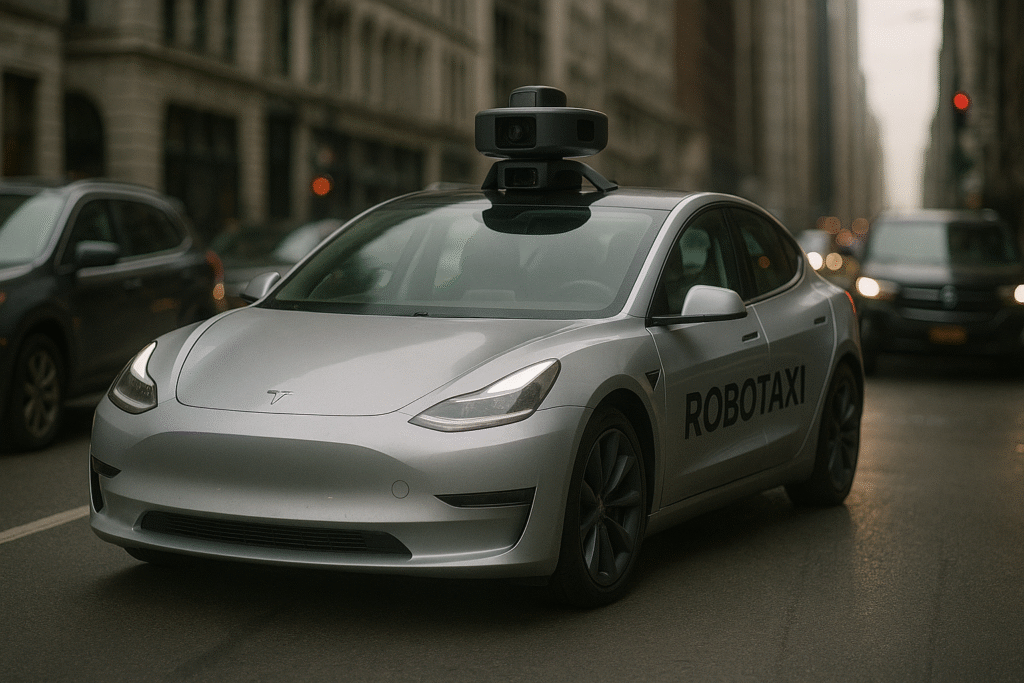
The ride of the future on the streets of San Francisco
San Francisco is the ultimate testing ground for autonomous vehicles. The city has steep hills, unpredictable fog, endless cyclists, and traffic that can switch from gridlock to drag race in seconds. If Tesla wants its Tesla Robotaxi service to succeed anywhere, this is the place to prove it.
Last weekend, I climbed into a 2026 Tesla Model Y fitted with the latest Full Self-Driving (FSD) Beta. This isn’t the commercial Robotaxi fleet yet, but the system inside the car is essentially what Tesla plans to deploy when the Tesla Robotaxi launch in Austin rolls out to other U.S. cities.
Hands hovering above the wheel, I let the system take over through downtown San Francisco, weaving between cable cars, delivery vans, and impatient Uber drivers. What followed was a fascinating glimpse into both the promise – and the limits – of Tesla’s vision of autonomy.
First impressions: confidence on the hills, hesitation at intersections
San Francisco’s infamous hills can rattle even seasoned drivers, but the Tesla Robotaxi handled inclines with poise. On California Street, the Model Y eased up the steep grade without jerks, then managed a perfectly smooth stop at the top.
But intersections were another story. At a busy four-way stop in the Mission District, the Robotaxi waited too long, missing multiple chances to go. A human driver behind us leaned on the horn. FSD’s decision-making is cautious to the point of being awkward – a recurring theme throughout the ride.
On Market Street, however, the system redeemed itself. Surrounded by buses and cyclists, it navigated a lane merge as if it had been driving there for years. It felt almost human in its timing and assertiveness.
Tesla Robotaxi vs Waymo in San Francisco
The Bay Area is also Waymo’s home turf, and its fleet of Jaguar I-PACE Robotaxis is a common sight around SoMa and Chinatown. That makes San Francisco the perfect battleground for the Tesla Robotaxi vs Waymo showdown.
- Waymo’s approach: Uses a mix of lidar, radar, and cameras. Its system is ultra-cautious, sometimes freezing up in complex situations.
- Tesla’s approach: Relies only on cameras and neural networks. It feels more fluid and human-like – but that also means more risks if the system misjudges.
- In practice: During my ride, Tesla’s Robotaxi felt bolder than Waymo. But when an SFPD cruiser sped past with sirens on, the Tesla hesitated too long before yielding. Waymo, in comparison, tends to pull over instantly when emergency vehicles appear.
The difference boils down to philosophy: Tesla is betting that vision-only AI can master driving, while Waymo is throwing sensors at the problem. In San Francisco, both approaches are being stress-tested daily.
Tesla Robotaxi release date and event news
Tesla has not given a firm Robotaxi release date for San Francisco yet. Elon Musk has teased that Austin will be the first launch city, with San Francisco expected to follow closely behind due to its existing FSD user base.
The upcoming Tesla Robotaxi event expected later this year is set to reveal the production design, booking process, and pricing model. If you’re wondering how to watch the Tesla Robotaxi event, Tesla will live-stream it on its official site, as well as simulcasting on YouTube and X (formerly Twitter).
Here’s a quick look at the timeline of what we know so far:
| Event | Location | Date (expected) | How to watch |
|---|---|---|---|
| Tesla Robotaxi unveiling | Austin, Texas | 2025 (official date TBA) | Live on Tesla Robotaxi site, YouTube, X |
| San Francisco testing expansion | San Francisco, CA | Late 2025 (after Austin launch) | Updates via Tesla press site & official channels |
| National rollout announcement | United States | 2026+ (phased launch) | Live on Tesla Robotaxi site |
How much will Tesla Robotaxi cost?
One of Musk’s boldest claims is that the Tesla Robotaxi price will be cheaper than a bus ticket. That means rides could be in the $3–$5 range – a fraction of the $20–$25 you’d pay for an Uber across town.
In San Francisco, where public transit is reliable but often crowded, that kind of affordability could flip the mobility market on its head. But it also raises the question: can Tesla sustain such low prices while still making money?
Edge cases: where FSD still struggles in San Francisco
During my three-hour ride, the Tesla Robotaxi shined in clear traffic but stumbled in classic San Francisco “edge cases.”
- Cyclists: On Valencia Street, the Robotaxi nudged uncomfortably close to a bike lane. I intervened, but it was a reminder that not all human unpredictability is accounted for.
- Emergency vehicles: As noted, it hesitated when an ambulance appeared, which could have been dangerous.
- Fog: Crossing the Golden Gate Bridge in early morning fog, visibility was limited. The cameras seemed to cope, but lane markings blurred and the system slowed dramatically.
- Aggressive drivers: At one point in Chinatown, a delivery van cut us off sharply. The Robotaxi slammed the brakes harder than any human driver would – safe, but jarring.
Regulation and reality check
Unlike Austin, San Francisco regulators are already familiar with autonomous vehicle operations, thanks to Waymo and Cruise. That makes it easier for Tesla to eventually secure permits, but California’s DMV will demand rigorous safety data.
For now, state law still requires human safety drivers behind the wheel. I noticed several other Model Ys with Robotaxi decals in SoMa, all supervised by drivers. That means Tesla is testing aggressively, even if it hasn’t officially launched.
The bigger picture: Tesla’s gamble vs Silicon Valley rivals
Tesla’s bet on vision-only AI is controversial. Experts argue lidar and radar provide critical redundancy, while Musk insists cameras are enough.
- Waymo: 250,000 driverless rides per week across multiple cities.
- Zoox (Amazon): Testing purpose-built shuttles in California.
- Tesla: Still requires human supervision – but has the scale advantage, since every Tesla sold can be upgraded with FSD.
If Tesla can crack San Francisco, it could leapfrog its rivals overnight. If not, Waymo’s cautious but proven approach may continue to dominate.
Final thoughts: Is San Francisco ready for Tesla Robotaxi?
After spending hours in a Tesla Robotaxi in San Francisco, my verdict is this: the system is closer than skeptics admit, but farther from true autonomy than Musk promises.
It handles routine driving impressively well, even on steep hills and in messy traffic. But when the city throws real chaos – cyclists, fire trucks, dense fog – it still falters.
For now, San Francisco riders should expect Tesla Robotaxi to feel like a bold experiment, not yet a replacement for Uber or Waymo. The real test will come at the Tesla Robotaxi launch event, when Musk unveils pricing and service details.
Until then, San Francisco remains the proving ground – and Tesla’s boldest bet.